Download PDF Werkausgabe, Band 1: Tractatus logico-philosophicus / Tagebücher 1914-1916 / Philosophische Untersuchungen, by Ludwig Wittgenstein
Nun, wenn Sie ein zusätzliches Konzept Führer zu wählen haben, genau das, was können Sie tun? Es wird sicherlich viel besser und viel leichter zu entdecken Werkausgabe, Band 1: Tractatus Logico-philosophicus / Tagebücher 1914-1916 / Philosophische Untersuchungen, By Ludwig Wittgenstein in dieser Internet-Seite, da wir Sie die direkt an höchstwahrscheinlich verbinden bieten Website zu führen. Es wird sicherlich viel einfacher und schneller, um es zu bekommen. Genau hier, Soft-Datei wird Ihnen helfen, wirklich zu sparen und es auch jedes Mal, überprüfen Sie wollen. Natürlich wird es beschränken Sie es nicht in bestimmten Ort zu lesen.
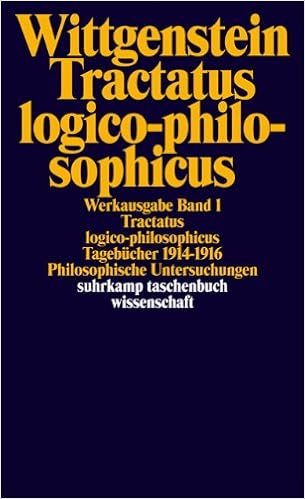
Werkausgabe, Band 1: Tractatus logico-philosophicus / Tagebücher 1914-1916 / Philosophische Untersuchungen, by Ludwig Wittgenstein

Download PDF Werkausgabe, Band 1: Tractatus logico-philosophicus / Tagebücher 1914-1916 / Philosophische Untersuchungen, by Ludwig Wittgenstein
Werkausgabe, Band 1: Tractatus Logico-philosophicus / Tagebücher 1914-1916 / Philosophische Untersuchungen, By Ludwig Wittgenstein . Geben Sie uns 5 Minuten so gut wie wir Ihnen das beste Buch zeigen werden heute zu lesen. Das ist es, die Werkausgabe, Band 1: Tractatus Logico-philosophicus / Tagebücher 1914-1916 / Philosophische Untersuchungen, By Ludwig Wittgenstein , die beste Wahl für viele besseres Lesebuch sein. Ihre 5 - mal wird sicherlich nicht verbringen weggeworfen durch diese Website zu lesen. Sie können Führer nehmen als eine Ressource besseres Konzept. Mit Bezug Führungen Werkausgabe, Band 1: Tractatus Logico-philosophicus / Tagebücher 1914-1916 / Philosophische Untersuchungen, By Ludwig Wittgenstein , die mit Ihren Anforderungen aufgestellt werden können , ist irgendwann einmal herausfordernd. Aber hier, das ist so sehr einfach. Sie könnten das Beste , was Buch Werkausgabe, Band 1: Tractatus Logico-philosophicus / Tagebücher 1914-1916 / Philosophische Untersuchungen, By Ludwig Wittgenstein , die Sie überprüfen können.
Dieses Buch Werkausgabe, Band 1: Tractatus Logico-philosophicus / Tagebücher 1914-1916 / Philosophische Untersuchungen, By Ludwig Wittgenstein wird erwartet , dass unter der besten Anbieter Veröffentlichung sein , dass Sie zufrieden fühlen vollständig machen zu bekommen und es auch für fertige zu überprüfen. Wie konnte üblich verstanden wird jedes Buch bestimmte Punkte, die sicherlich jemand interessiert viel machen. Auch kommt es vom Autor, Art, Inhalt oder sogar dem Autor. Dennoch nehmen viele Menschen zusätzlich Guide Werkausgabe, Band 1: Tractatus Logico-philosophicus / Tagebücher 1914-1916 / Philosophische Untersuchungen, By Ludwig Wittgenstein basiert auf dem Stil und auch Titel , die sie in überrascht zu machen. Und hier ist Werkausgabe, Band 1: Tractatus Logico-philosophicus / Tagebücher 1914-1916 / Philosophische Untersuchungen, By Ludwig Wittgenstein ist ganz für Sie vorgeschlagen , weil es interessante Titel und Motiv zu überprüfen hat.
Sind Sie wirklich ein Fan von diesem Werkausgabe, Band 1: Tractatus Logico-philosophicus / Tagebücher 1914-1916 / Philosophische Untersuchungen, By Ludwig Wittgenstein Wenn das so ist, warum Sie diese Publikation jetzt nicht nehmen? Seien Sie der erste Person , die wie und auch dieses Buch führen Werkausgabe, Band 1: Tractatus Logico-philosophicus / Tagebücher 1914-1916 / Philosophische Untersuchungen, By Ludwig Wittgenstein, so könnte man den Faktor und auch Nachrichten aus dieser Veröffentlichung zu erhalten. Es macht nichts verwirrt werden , wo es zu erhalten. Da die verschiedenen anderen teilen wir die connect sowie Download der Soft - Daten ebook Werkausgabe, Band 1: Tractatus Logico-philosophicus / Tagebücher 1914-1916 / Philosophische Untersuchungen, By Ludwig Wittgenstein So zu besuchen, können Sie nicht auf die veröffentlichte Publikation bringen Werkausgabe, Band 1: Tractatus Logico-philosophicus / Tagebücher 1914-1916 / Philosophische Untersuchungen, By Ludwig Wittgenstein überall.
Die Existenz der Online-Publikation oder weicher Daten der Werkausgabe, Band 1: Tractatus Logico-philosophicus / Tagebücher 1914-1916 / Philosophische Untersuchungen, By Ludwig Wittgenstein wird sicherlich Menschen lindern , das Buch zu erhalten. Es wird darüber hinaus noch mehr Zeit sparen nur den Titel oder Autor oder Autor suchen zu erhalten , bis die Veröffentlichung Werkausgabe, Band 1: Tractatus Logico-philosophicus / Tagebücher 1914-1916 / Philosophische Untersuchungen, By Ludwig Wittgenstein offenbart. Dann können Sie die Web - Link herunterladen besuchen zu besuchen , die von dieser Internet - Seite gegeben. Also, das wird sicherlich eine sehr gute Zeit , um diese Publikation zu beginnen genießen Werkausgabe, Band 1: Tractatus Logico-philosophicus / Tagebücher 1914-1916 / Philosophische Untersuchungen, By Ludwig Wittgenstein zu lesen. Ständig große Zeit mit Publikation Werkausgabe, Band 1: Tractatus Logico-philosophicus / Tagebücher 1914-1916 / Philosophische Untersuchungen, By Ludwig Wittgenstein, durchweg gute Zeit mit Geld ausgeben!
Über den Autor und weitere Mitwirkende
Ludwig Wittgenstein wurde am 26. April 1889 als Sohn des Großindustriellen Karl Wittgenstein in Wien geboren und starb am 29. April 1951 in Cambridge. Er erhielt zunächst Privatunterricht und besuchte ab 1903 eine Realschule in Linz. Er studierte von 1906 bis 1908 Ingenieurswissenschaften an der Technischen Hochschule Charlottenburg und wechselte dann für weitere drei Jahre nach Manchester. Dort forschte er zur Aeronautik. Er begann, sich für philosophische Themen zu interessieren und trat 1912 in das Trinity College in Cambridge. Ab diesem Jahr begann Wittgenstein mit den Arbeiten an seinem ersten philosophischen Werk, der Logisch-philosophischen Abhandlung, die er in einem Tagebuch als Notizen bis 1917 festhielt. Auch während seiner Zeit als österreichischer Freiwilliger im Ersten Weltkrieg arbeitete er daran weiter, bis er das Werk schließlich im Sommer 1918 vollendete. Es erschien jedoch erst 1921 in einer fehlerhaften Version in der Zeitschrift Annalen der Naturphilosophie. 1922 wurde schließlich eine zweisprachige Ausgabe unter dem heute bekannten Titel der englischen Übersetzung veröffentlicht: Tractatus Logico-Philosophicus. Abgesehen von zwei kleineren philosophischen Aufsätzen und einem Wörterbuch für Volksschulen blieb die Logisch-philosophische Abhandlung das einzige zu Lebzeiten veröffentlichte Werk Wittgensteins. 1953 erschein posthum das Werk Philosophische Untersuchungen.
Produktinformation
Taschenbuch: 620 Seiten
Verlag: Suhrkamp Verlag; Auflage: 1. (1984)
Sprache: Deutsch
ISBN-10: 3518281011
ISBN-13: 978-3518281017
Größe und/oder Gewicht:
10,8 x 3,2 x 17,7 cm
Durchschnittliche Kundenbewertung:
4.5 von 5 Sternen
3 Kundenrezensionen
Amazon Bestseller-Rang:
Nr. 152.512 in Bücher (Siehe Top 100 in Bücher)
Ich habe diese Buch für eine Veranstaltung in der Uni gebraucht und war froh fündig geworden zu sein. Die Lieferung erfolgte schnell und der Artikel war in einwandfreiem Zustand!
Die Legenden von Wittgensteins "Mystik" im Tractatus sind Legende, das Werk eine perfekte Überschneidung aus strenger Logik und existenziellem Engagement.Doch der wahre Geheimtip in diesem Band sind die "Philosophischen Untersuchungen", Wittgensteins zweites großes (posthum veröffentlichtes) Werk, in dem er die "schweren Irrtümer" des ersten Werks korrigieren will und Wege einschlägt, die sowohl Metaphysiker als auch Neopositivisten einige Meter zurück auf den Boden bringt. Besonders zu loben ist dabei sein schnippischer Humor und die Methode, Argumentationslücken in den jeweiligen Redearten aufzuzeigen und die Deutung dem Leser zu überlassen. Wunderbar!
“ But I did not get my picture of the world by satisfying myself of its correctness: nor do I have it because I am satisfied of its correctness. No: it is the inherited background against which I distinguish between true and false.â€(OC 94).“Superstition is nothing but belief in the causal nexus.†TLP 5.1361"Now if it is not the causal connections which we are concerned with, then the activities of the mind lie open before us." "The Blue Book†p6 (1933)“We feel that even when all possible scientific questions have been answered, the problems of life remain completely untouched. Of course, there are then no questions left, and this itself is the answer.†TLP 6.52 (1922)“Nonsense, Nonsense, because you are making assumptions instead of simply describing. If your head is haunted by explanations here, you are neglecting to remind yourself of the most important facts.†Z 220“Philosophy simply puts everything before us and neither explains nor deduces anything…One might give the name ‘philosophy’ to what is possible before all new discoveries and inventions.†PI 126“The more narrowly we examine actual language, the sharper becomes the conflict between it and our requirement. (For the crystalline purity of logic was, of course, not a result of investigation: it was a requirement.)â€PI 107“The wrong conception which I want to object to in this connexion is the following, that we can discover something wholly new. That is a mistake. The truth of the matter is that we have already got everything, and that we have got it actually present; we need not wait for anything. We make our moves in the realm of the grammar of our ordinary language, and this grammar is already there. Thus, we have already got everything and need not wait for the future.†(said in 1930) Waismann “Ludwig Wittgenstein and the Vienna Circle (1979)p183“Here we come up against a remarkable and characteristic phenomenon in philosophical investigation: the difficulty---I might say---is not that of finding the solution but rather that of recognizing as the solution something that looks as if it were only a preliminary to it. We have already said everything.---Not anything that follows from this, no this itself is the solution!….This is connected, I believe, with our wrongly expecting an explanation, whereas the solution of the difficulty is a description, if we give it the right place in our considerations. If we dwell upon it, and do not try to get beyond it.†Zettel p312-314When thinking about Wittgenstein, I often recall the comment attributed to Cambridge Philosophy professor C.D. Broad (who did not understand nor like him). “Not offering the chair of philosophy to Wittgenstein would be like not offering the chair of physics to Einstein!" I think of him as the Einstein of intuitive psychology. Though born ten years later, he was likewise hatching ideas about the nature of reality at nearly the same time and in the same part of the world and like Einstein nearly died in WW1. Now suppose Einstein was a suicidal homosexual recluse with a difficult personality who published only one early version of his ideas that were confused and often mistaken, but became world famous; completely changed his ideas but for the next 30 years published nothing more, and knowledge of his new work, in mostly garbled form, diffused slowly from occasional lectures and students notes; that he died in 1951 leaving behind over 20,000 pages of mostly handwritten scribblings in German, composed of sentences or short paragraphs with, often, no clear relationship to sentences before or after; that he wrote in a Socratic style with 3 distinct persons in the dialog—the narrator, the interlocutor and the commentator (usually W’s view) whose comments were blended together by most readers, thus completely vitiating the whole elucidatory and therapeutic thrust, that these were cut and pasted from other notebooks written years earlier with notes in the margins, underlinings and crossed out words, so that many sentences have multiple variants; that his literary executives cut this indigestible mass into pieces, leaving out what they wished and struggling with the monstrous task of capturing the correct meaning of sentences which were conveying utterly novel views of how the universe works and that they then published this material with agonizing slowness (not finished after half a century) with prefaces that contained no real explanation of what it was about; that he became as much notorious as famous due to many statements that all previous physics was a mistake and even nonsense, and that virtually nobody understood his work, in spite of hundreds of books and tens of thousands of papers discussing it; that many physicists knew only his early work in which he had made a definitive summation of Newtonian physics stated in such extremely abstract and condensed form that it was difficult to decide what was being said; that he was then virtually forgotten and that most books and articles on the nature of the world and the diverse topics of modern physics had only passing and usually erroneous references to him, and that many omitted him entirely; that to this day, over half a century after his death, there were only a handful of people who really grasped the monumental consequences of what he had done. This, I claim, is precisely the situation with Wittgenstein.Had W lived into his 80's he would have been able to directly influence Searle, Symons, Habermas and countless other students of behavior. If his brilliant friend Frank Ramsey had not died in his youth, a highly fruitful collaboration would almost certainly have ensued. If his student and colleague Alan Turing had become his lover, one of the most amazing collaborations of all time would likely have evolved. In any one case the intellectual landscape of the 20th century would have been different and if all 3 had occurred it would almost certainly have been very different. Instead he lived in relative intellectual isolation, few knew him well or had an inkling of his ideas while he lived, and only a handful within philosophy have any real grasp of his work today. He could have shined as an engineer(he has an aviation patent), a mathematician (he sketched out a proof of Euler's theorem, since shown to be valid, and grasped the psychological foundations of math , incompleteness, infinity etc., as perhaps no one else has to this day), a physiologist (he did wartime research in it), a musician (he played instruments and had a renowned talent for whistling), an architect (the house he designed and constructed for his sister still stands), or an entrepreneur (he inherited one of the largest fortunes in the world but gave it all away). It is a miracle he survived the trenches and prison camps (while writing the Tractatus) in WW1, many years of suicidal depressions (3 brothers succumbed to them), avoided being trapped in Austria and executed by the Nazis (he was partly Jewish), and that he was not persecuted for his homosexuality and driven to suicide like his friend Turing. He realized nobody understood what he was doing and might never (not surprising as he was half a century ahead of psychology and philosophy, which only recently have started accepting that our brain is an evolved organ like our heart.)Before TLP there is a ProtoTractatus and a few desultory comments made even earlier. It is a remarkable document which continues to seduce some the best minds in philosophy, with new books and articles dealing partly or entirely with it appearing frequently over a century after it was first conceived. The first thing to note is that W later rejected it entirely for reasons he spent the rest of his life explaining. You can see the review of S Guha above for a splendid précis of some of what TLP means IF you assume phrases like "propositions are pictures of reality" have a clear meaning (they don't). He was doing philosophy (descriptive psychology) as though the mind was a logical mathematical machine that processed facts, and behavior was the result. Thus, long before computers W gave the ultimate statement of what was half a century later to become known as strong AI, CTM (Computational Theory of Mind) and most recently DSM (Dynamic Systems Theory). Eventually, W realized that perception and memory were the raw material acted upon by our innate psychology (EP) and logic and math were some of the results. Being able to say or understand anything presupposed EP and trying to make logic primary leads to incoherence, as is evident throughout TLP (and the explanation for its many bizarre statements-see e.g. Hutto). Even so, one can "understand" TLP in the sense that one can state the confusions he labored under and which most of the world still does.In the decades after TLP, W evolved slowly and his ideas crystallized into a unique and amazingly deep and prescient description of behavior not yet fully appreciated by even his brightest and most ardent admirers (e.g. Hutto, Stern, DMS etc.). Although W wrote thousands of pages and is the most discussed philosopher in modern times, only a few have any real grasp of what he did and how it anticipates in detail many of the latest advances in psychology and philosophy (descriptive psychology). It is essential to first read some of the commentaries on his later work by others. One of the best is that of Daniele Moyal-Sharrock (DMS) whose 2004 volume "Understanding Wittgenstein's On Certainty" is mandatory for every educated person, and perhaps the best starting point for understanding Wittgenstein, psychology, philosophy and life, since it explains the unconscious, axiomatic structure of animal behavior. Next I would suggest the writings of Daniel Hutto, especially his "Wittgenstein and the End of Philosophy"(2004). However (in my view) like all analyses, they fall far short of grasping his unique and revolutionary advances in describing behavior by failing to put them in a broad evolutionary and contemporary scientific context, which I will attempt in skeletal outline here. And one ought to see everthing by Rupert Read, Gordon Baker and Peter Hacker. Finally, all of Searle should be read, with special attention to "Rationality in Action" and his more recent works. Though Searle does not say and seems to be unaware, most of his work follows directly from that of W.To say that Searle has carried on W's work is not to say that it is a direct result of W study, but rather that because there is only ONE human psychology (for the same reason there is only ONE human cardiology), that anyone accurately describing behavior must be voicing some variant or extension of what W said (assuming W is correct). I find most of Searle foreshadowed in W, including versions of the famous Chinese room argument against Strong AI. Incidentally, if the Chinese Room interests you then you should read Victor Rodych's xlnt ,but virtually unknown, supplement on the CR--"Searle Freed of Every Flaw". Rodych has also written a series of superb papers on W's philosophy of mathematics --i.e., the EP (Evolutionary Psychology) of the axiomatic System 1 Primary Language Games (PLG's) of counting as extended into the endless System 2 SLG's (Secondary Language Games) of math. I will also note that nobody who promotes Strong AI, CTM or DSM seems to be aware that W's Tractatus is the most striking and powerful statement of their viewpoint ever penned (i.e., behavior as the logical processing of facts--i.e., "information processing"--see the work of Hutto and Searle for a lovely dissection of this rats nest). Of course decades later (but before the digital computer was a gleam in Turing's eye) he described in great detail why CTM was an incoherent description of mind that must be replaced by psychology (or you can say this is all he did for the rest of his life).Wittgenstein is for me easily the most brilliant thinker on human behavior and TLP and Philosophical Investigations(PI) are his most famous works. His work as a whole shows that all behavior is an extension of innate true-only axioms (see "On Certainty" for his final extended treatment of this idea) and that our conscious ratiocination emerges from unconscious machinations. His corpus can be seen as the foundation for all description of animal behavior, revealing how the mind works and indeed must work. The "must" is entailed by the fact that all brains share a common ancestry and common genes and so there is only one basic way they work, that this necessarily has an axiomatic structure, that all higher animals share the same evolved psychology based on inclusive fitness, and that in humans this is extended into a personality based on throat muscle contractions (language) that evolved to manipulate others (with variations that can be regarded as trivial). This book, and arguably all of W's work and all useful discussion of behavior, is a development of or variation on these ideas. Another major theme here, and of course in all discussion of human behavior, is the need to separate the automatisms which underlie behavior from the effects of culture. Though few philosophers, psychologists, anthropologists, sociologists etc., explicitly discuss this, it can be seen as the major problem they are dealing with. I suggest it will prove of the greatest value to consider W's work and most of his examples as an effort to tease apart not only fast and slow thinking (e.g., perceptions vs dispositions--see below), but nature and nurture.What he eventually laid out are the foundations of evolutionary psychology (EP), or if you prefer, psychology, cognitive linguistics, intentionality, higher order thought or just animal behavior. Sadly, few realize that his works are a vast and unique textbook of descriptive psychology that is as relevant now as the day it was written. He is almost universally ignored by psychology and other behavioral sciences and humanities, and even those few in philosophy who have more or less understood him, have not carried the analysis to its logical (psychological) conclusion, nor realized the extent of his anticipation of the latest work on EP and cognitive illusions (TOM, framing, the two selves of fast and slow thinking etc.,--see below). His heir apparent, John Searle, refers to him periodically and his work can be seen as a straightforward extension of W's, but he does not really get that this is what he is doing. Other leading W analysts such as Hutto and Moyal-Sharrock do marvelously but (in my view) stop short of putting him in the center of current psychology, where he certainly belongs.His last works describe the two selves and the multifarious language games of fast and slow thinking, and, by starting from them and reading backwards to the proto-Tractatus, one sees how he became the first to grasp the identity of language, thought and reality. It should be clear that insofar as they are coherent and correct, all accounts of behavior are describing the same phenomena and ought to translate easily into one another. Thus the recently fashionable themes of "Embodied Mind" and "Radical Enactivism" should flow directly from and into W's work. However almost nobody is able to follow his example of avoiding jargon and sticking to perspicuous examples, so even the redoubtable Hutto (see below) has to be heavily filtered to see that this is true, and even he does not get how completely W has anticipated the latest work in fast and slow, two-self embodied thinking (acting).W can also be regarded as a pioneer in evolutionary cognitive linguistics--the Top Down analysis of the mind and its evolution via the careful analysis of examples of language use in context, by exposing the many varieties of language games and the relationships between the primary games of the true-only unconscious, axiomatic fast thinking of perception, memory and reflexive emotions and acts (often described as the subcortical and primitive cortical reptilian brain first-self functions), and the later evolved higher cortical dispositional conscious abilities of believing, knowing, thinking etc. that constitute the true or false propositional secondary language games of slow thinking that are the network of cognitive illusions that constitute the second-self or personality. He dissects hundreds of language games showing how the true-only perceptions, memories and reflexive actions of system one grade into the thinking, remembering, and understanding of system two dispositions, and many of his examples also address the nature/nurture issue explicitly. With this evolutionary perspective, his later works are a breathtaking revelation of human nature that is entirely current and has never been equaled. Many perspectives have heuristic value, but I find that this evolutionary two systems view not only lets me understand W, but cuts like a hot knife through the frozen butter of all discussions of higher order behavior. To repeat Dobzhansky's famous comment: "Nothing in biology makes sense except in the light of evolution." And nothing in philosophy makes sense except in the light of evolutionary psychology.The failure (in my view) of even the best thinkers (with a few possible exceptions) to fully grasp W's significance is partly due to the limited attention "On Certainty" (OC) and his other 3rd period works have received, but even more to the inability to understand how profoundly our view of philosophy, anthropology, sociology, linguistics, politics, law, morals, ethics, religion, aesthetics, literature (all of them being descriptive psychology), alters once we accept this evolutionary point of view. The dead hand of the blank slate view of behavior still rests heavily on most people, pro or amateur and is the default of the second self of slow thinking conscious System 2,(which is oblivious to the fact that the groundwork for all behavior lies in the unconscious, fast thinking axiomatic structure of System 1). System 1 overlaps with "mirroring"(Goldman), "neural resonance"(Gallagher), "biosemantics"(Millikan), and "biosemiotics"(Hutto). Steven Pinker's brilliant `The Blank Slate: the modern denial of human nature' is highly recommended preparation, even though it is now dated and limited in various ways, and he has no clue about Wittgenstein, and hence of what can be regarded as the first and best really deep investigation into the foundations of human nature. Also, he seems not to grasp that the Blank Slate view is an expression of the cognitive illusions that constitute our mental life.The common ideas (e.g., the subtitle of one of Pinker's books "The Stuff of Thought: language as a window into human nature") that language is a window on or some sort of translation of our thinking or even (Fodor) that there must be some other "Language of Thought" of which it is a translation, were rejected by W, who tried to show, with hundreds of continually reanalyzed perspicacious examples of language in action, that language is the best picture we can ever get of thinking, the mind and human nature, and his whole corpus can be regarded as the development of this idea. He rejected the idea that the Bottom Up approaches of physiology, experimental psychology and computation could reveal what his Top Down deconstructions of Language Games (LG's) did. The difficulties he noted are to understand what is always in front of our eyes and to capture vagueness ("The greatest difficulty in these investigations is to find a way of representing vagueness" LWPP1, 347). And so, speech (i.e., oral muscle contractions, the principal way we can interact) is not a window into the mind but is the mind itself, which is expressed by acoustic blasts about past, present and future acts (i.e., our speech using the later evolved Secondary Language Games (SLG's) of the Second Self--the dispositions --imagining, knowing, meaning, believing, intending etc.). As with his other aphorisms I suggest one should take seriously his comment that even if God could look into our mind he could not see what we are thinking--this should be the motto of the Embodied Mind. That is, since all higher behavior originates in the neural automatisms of system 1, even I don't know specifically what I am going to say.Some of W's favorite topics in his later second and his third periods are the different (but interdigitating) LG's of fast and slow thinking (System 1 and 2 or roughly PLG's and SLG's), the epiphenomenality of our second self and mental life (i.e., of our personality), the impossibility of private language and the axiomatic structure of behavior. The PLG's are utterances by and descriptions of our involuntary, System 1, fast thinking, true only, nonpropositional, untestable mental states ("it hurts") - our perceptions and memories and involuntary acts (including System 1 Truths and Understanding Of Agency -UOA1), while the evolutionarily later SLG's are expressions or descriptions of voluntary, System 2, slow thinking, testable true or false, propositional, Truth2 and UOA2, dispositional (and often counterfactual) imagining, supposing, intending, thinking, knowing, believing etc. A useful heuristic is to separate behavior and experience into Intentionality 1 and Intentionality 2 (e.g., Thinking 1 and Thinking 2 etc.) and even into Truths 1 (T only axioms) and Truths 2 (empirical extensions or "Theorems" which in some cases can be False). He recognized that `Nothing is Hidden'--i.e., our whole higher psychology and all the answers to all truly philosophical questions (i.e., ones not scientific) are here in our language (our life) and that the difficulty is not to find the answers but to recognize them as always here in front of us--we just have to stop trying to look deeper (e.g., "The greatest danger here is wanting to observe oneself." LWPP1, 459). Introspection gives nothing but language gives everything.W makes these points throughout his works in countless examples and again his whole corpus can be regarded as the effort to make them clear. W showed that standard ways of describing behavior (i.e., most of philosophy, and much of descriptive psychology, anthropology, sociology, economics, etc.) are either demonstrably false or incoherent. Once we understand W, we realize the absurdity of regarding "language philosophy" as a separate study apart from other areas of behavior, since language is just another name for the mind. And, when W says that understanding behavior is in no way dependent on the progress of psychology (e.g., his oft-quoted assertion "The confusion and barrenness of psychology is not to be explained by calling it a `young science' --but cf. another comment that I have never seen quoted "Is scientific progress useful to philosophy? Certainly. The realities that are discovered lighten the philosophers task. Imagining possibilities." (LWPP1, 807). So, he is not legislating the boundaries of science but pointing out that our behavior (mostly speech) is the clearest picture possible of our psychology and that all discussions of higher order behavior are plagued by conceptual confusions. FMRI, PET, TCMS, iRNA, computational analogs, AI and all the rest are fascinating and powerful ways to extend our innate axiomatic psychology, but all they can do is provide the physical basis for our behavior and facilitate our analysis of language games, while our EP remains unchanged (unless genetic engineering is unleashed to change it--but then it won't be us anymore). The true-only axioms most thoroughly explored in `'On Certainty'' are W's (and later Searle's) "bedrock" or "background" (EP), which is traceable to the automated true-only reactions of bacteria, which evolved and operates by the mechanism of inclusive fitness (IF). See the recent works of Trivers and others for a popular intro to IF or Bourke's superb "Principles of Social Evolution" for a pro intro.Beginning with their innate true-only, nonempirical (automated and nonchangeable) responses to the world, animals extend their axiomatic understanding via deductions into further true only understandings ("theorems" as we might call them, but of course like many words, this is a complex language game even in the context of mathematics). Tyrannosaurs and mesons become as unchallengeable as the existence of our two hands or our breathing. This dramatically changes ones view of human nature. Theory of Mind (TOM) is not a theory at all (see Hutto) but a group of true-only Understandings Of Agency (UOA a term I devised 10 years ago) which newborn animals (including flies and worms if UOA is suitably defined) have and subsequently extend greatly (in higher eukaryotes). However W noted that for much of intentionality there are System 1 and System 2 versions (language games)-the fast unconscious UOA1 and the Slow conscious UOA2 and of course these are multifaceted phenomena.Likewise, the Theory of Evolution ceased to be a theory for any normal, rational, intelligent person before the end of the 19th century and for Darwin at least half a century earlier. One CANNOT help but incorporate T. rex and all that is relevant to it into our innate background via the inexorable workings of EP. Once one gets the logical (psychological) necessity of this it is truly stupefying that even most of the brightest do not grasp this most basic fact of human life (with a tip of the hat to Kant, Searle and a few others) which was laid out in great detail in "On Certainty". Incidentally, the equation of logic and our axiomatic psychology is essential to understanding W and human nature (as DMS, but afaik nobody else, points out).So, most of our shared public experience (culture) becomes a true-only extension of our axiomatic EP and cannot be found mistaken without threatening our sanity. A corollary, nicely explained by DMS and elucidated in his own unique manner by Searle, is that the skeptical view of the world and other minds (and a mountain of other nonsense including the Blank Slate) cannot really get a foothold, as "reality" is the result of involuntary fast thinking axioms and not testable true or false propositions.I think it is clear that the innate true-only axioms W is occupied with throughout his work, and almost exclusively in OC (his last work), are equivalent to the fast thinking or System 1 that is at the center of current research (e.g., see Kahneman--"Thinking Fast and Slow", but he has no idea W laid out the framework some 75 years ago), which is involuntary and unconscious and which corresponds to the mental states of perception (including UOA1) and memory and involuntary acts, as W notes over and over in endless examples. One might call these "intracerebral reflexes"(maybe 99% of all our cerebration if measured by energy use in the brain). Our slow or reflective, more or less "conscious" (beware another network of language games!) second-self brain activity corresponds to what W characterized as "dispositions" or "inclinations", which refer to abilities or possible actions, are not mental states, and do not have any definite time of occurrence. But disposition words like "knowing", "understanding", "thinking", "believing", which W discussed extensively, have at least two basic uses or language games. One is a peculiar philosophical use (but graduating into everyday uses) exemplified by Moore (whose papers inspired W to write OC), which refers to the true-only sentences resulting from direct perceptions and memory, i.e., our innate axiomatic System 1 psychology (`I know these are my hands'), and their normal use as dispositions, which can be acted out and which can become true or false (`I know my way home').The investigation of involuntary fast thinking has revolutionized psychology, economics (e.g., Kahneman's Nobel prize) and other disciplines under names like "cognitive illusions", "priming", "framing", "heuristics" and "biases". Of course these too are language games so there will be more and less useful ways to use these words, and studies and discussions will vary from "pure" System 1 to combinations of 1 and 2 (the norm as W made clear), but presumably not ever of slow System 2 dispositional thinking only, since any System 2 thought or intentional action cannot occur without involving much of the intricate network of "cognitive modules", "inference engines", "intracerebral reflexes", "automatisms", "cognitive axioms", "background" or "bedrock" (as W and later Searle call our EP).One of W's recurring themes was TOM, or as I prefer UOA (but of course he did not use these terms), which is the subject of major research efforts now. I recommend consulting the work of Ian Apperly, who is carefully dissecting UOA1 and 2 and who has recently become aware of Hutto, since Hutto has now characterized UOA1 as a fantasy (or rather insists that there is no `Theory' nor representation involved in UOA1--that being reserved for UOA2). However, like other psychologists, Apperly has no idea W laid the groundwork for this between 60 and 80 years ago.Another point made countless times by W was that our conscious mental life is epiphenomenal in the sense that it does not describe nor determine how we act. It is an obvious corollary of his descriptive psychology that it is the unconscious automatisms of System 1 that dominate and describe behavior and that the later evolved conscious dispositions (thinking, remembering, loving, desiring, regretting etc.) are mere icing on the cake. This is most strikingly borne out by the latest experimental psychology, some of which is nicely summarized by Kahneman in the book cited (see e.g., the chapter `Two Selves', but of course there is a huge volume of recent work he does not cite and endless other books and papers). It is an easily defensible view that much of the burgeoning literature on cognitive illusions, automatisms and higher order thought is wholly compatible with and straightforwardly deducible from W.Probably the leading exponent of W's ideas on the language games of inner and outer (the `Two Selves' operation of our personality or intentionality or EP etc. ) is the prolific Daniel Hutto (DH), whose `Radical Enactivism' is explained in numerous recent books and papers. It is a development of or version of the Embodied Mind ideas now current and, cleansed of its jargon, it is a straightforward extension of W's 2nd and 3rd period writings (though Hutto seems only intermittently aware of this). He is also author of the best deconstructions I know of Dennett's preposterous claim to be following in W's footsteps (in fact he is just repeating many classic mistakes (e.g. those in TLP!!) in grandiose fashion and hasn't a clue about W) and of Fodor's LOT and other nonsense. But of course one must read Searle too and the title of his famous review of Dennett's book says it well "Consciousness Explained Away". Incidentally, unlike most philosophers and other scholars, who make little or no effort to give the general public access to their papers, Hutto has put nearly every paper (though of course often just proofs and not the final paper) free online at [...]Throughout W's works, understanding is bedeviled by possible alternative and consequently often infelicitous translations from often unedited and handwritten German notes, with "Satz" being frequently incorrectly rendered as "proposition"(which is a testable or falsifiable statement) when referring to our nonfalsifiable psychological axioms, as opposed to the correct "sentence", which CAN be applied to our axiomatic true-only statements such as "these are my hands" or "Tyrannosaurs were large carnivorous dinosaurs that lived about 50 million years ago"(and since this is an unavoidable extension of our psychology, what does this imply about creationists?).Regarding my view of W as the major pioneer in EP, it seems nobody has noticed that he very clearly explained several times specifically and many times in passing, the psychology behind what later became known as the Wason Test--long a mainstay of EP research.Those wishing some specific comments on W's later works can see my reviews of OC, PI and books by Hutto and Searle which I will post soon.Finally, let me suggest that with this perspective, W in his later works is not obscure, difficult or irrelevant but scintillating, profound and crystal clear, that he writes aphoristically and telegraphically because we think and behave that way, and that to miss him is to miss one of the greatest intellectual adventures.
Werkausgabe, Band 1: Tractatus logico-philosophicus / Tagebücher 1914-1916 / Philosophische Untersuchungen, by Ludwig Wittgenstein PDF
Werkausgabe, Band 1: Tractatus logico-philosophicus / Tagebücher 1914-1916 / Philosophische Untersuchungen, by Ludwig Wittgenstein EPub
Werkausgabe, Band 1: Tractatus logico-philosophicus / Tagebücher 1914-1916 / Philosophische Untersuchungen, by Ludwig Wittgenstein Doc
Werkausgabe, Band 1: Tractatus logico-philosophicus / Tagebücher 1914-1916 / Philosophische Untersuchungen, by Ludwig Wittgenstein iBooks
Werkausgabe, Band 1: Tractatus logico-philosophicus / Tagebücher 1914-1916 / Philosophische Untersuchungen, by Ludwig Wittgenstein rtf
Werkausgabe, Band 1: Tractatus logico-philosophicus / Tagebücher 1914-1916 / Philosophische Untersuchungen, by Ludwig Wittgenstein Mobipocket
Werkausgabe, Band 1: Tractatus logico-philosophicus / Tagebücher 1914-1916 / Philosophische Untersuchungen, by Ludwig Wittgenstein Kindle
Werkausgabe, Band 1: Tractatus logico-philosophicus / Tagebücher 1914-1916 / Philosophische Untersuchungen, by Ludwig Wittgenstein PDF
Werkausgabe, Band 1: Tractatus logico-philosophicus / Tagebücher 1914-1916 / Philosophische Untersuchungen, by Ludwig Wittgenstein PDF
Werkausgabe, Band 1: Tractatus logico-philosophicus / Tagebücher 1914-1916 / Philosophische Untersuchungen, by Ludwig Wittgenstein PDF
Werkausgabe, Band 1: Tractatus logico-philosophicus / Tagebücher 1914-1916 / Philosophische Untersuchungen, by Ludwig Wittgenstein PDF